


Long-Term Firearm Storage Maintenance: A Complete Guide
Last Updated: November 5, 2026
Quick Summary
Firearm storage maintenance means cleaning a gun thoroughly, drying every metal surface, applying a thin protective coat, and keeping it in a dry, stable environment. Check it on a regular schedule so moisture and corrosion are caught early. The core rule is to clean, dry, protect and check.
- Clean all fouling from the bore, bolt face and moving parts before storing.
- Dry every metal part completely, since leftover moisture starts corrosion.
- Apply protectant sparingly; a thin film protects while heavy coats attract dust.
- Keep relative humidity in a stable, dry range, measured with a hygrometer.
- Inspect on a schedule and after events like moves, outages or wet trips.
Table of Contents
- Why Long-Term Firearm Storage Maintenance Matters
- Firearm Cleaning Before Storage: Preparing the Gun Properly
- Choosing a Storage Location and Controlling Humidity
- Selecting Long Term Gun Storage Bags, Cases, and Safes
- Building a Firearm Storage Inspection Schedule
- Returning a Stored Firearm to Service Safely
- Frequently Asked Questions
Why Long-Term Firearm Storage Maintenance Matters
Firearms that sit unused for months are exposed to the same enemies as any stored metal: moisture, residue and time. SEAL 1 builds its bio-based, non-toxic maintenance system around that reality, so the steps below show how to prepare a gun for storage, keep it protected and bring it back to service safely. The core rule is simple: clean thoroughly, dry completely, protect every metal surface, and check on it regularly.
Long-term storage is a different job from routine range cleaning. A gun cleaned after a range session still carries microscopic fouling and moisture that can sit against steel for months. Whether you store a single handgun or a full collection, the goal is the same: a clean, dry, lightly protected firearm in a stable environment.
Firearm Cleaning Before Storage: Preparing the Gun Properly
Firearm cleaning before storage removes the residue that invites corrosion. Fouling left in the bore, on the bolt face and around moving parts holds moisture against the metal, so cleaning comes before anything else.
A practical sequence works well for most firearms:
- Confirm the firearm is unloaded and remove the magazine, then lock the action open.
- Clean the bore with a solvent and patches until the patches come out clean.
- Wipe down the receiver, bolt, slide and trigger group with a cloth.
- Apply a CLP product to remove remaining carbon and residue.
The SEAL 1 CLP Plus® Paste is a bio-based, non-toxic paste that cleans, lubricates and protects in one step, and it is listed as safe for use on metal, wood and plastic surfaces. You can also pick up The Gun Rag, a microfiber cloth pre-saturated with SEAL 1 CLP Plus®, when you want the wipe-down and the protectant in one pass.

Field Stripping and Disassembly for Thorough Cleaning
Field stripping lets you reach the surfaces that a surface wipe-down misses. Disassemble only as far as your owner's manual describes for your model. Most semi-automatic pistols and modern rifles field-strip into a small number of major components, which gives you access to the slide rails, the barrel hood and the bolt carrier.
Clean each component separately and keep track of small parts such as springs and pins. For a side-by-side look at CLP options suited to pre-storage maintenance, compare the choices before you start. Reassembly errors are a common reason people skip storage prep, so take a photo of the layout before you start if it helps. Never disassemble past the level your manual allows.
Drying Metal Parts and Applying a Protective Coating
Drying matters as much as cleaning. Any moisture left on the metal, even from cleaning solvent, can start corrosion during storage. Wipe every part dry with a clean cloth and let the firearm air out briefly before applying the final coat.
Apply the protective layer sparingly. If your finishes are delicate, this guide covers oils that are safe for delicate finishes. The SEAL 1 CLP Plus® Liquid is a bio-based, non-toxic cleaner, lubricant and protectant for firearms. Work it onto metal surfaces, then wipe off the excess, since a thin film protects while a heavy coat can attract dust. Over-lubrication is a common mistake that gathers grit and gums up the action later, so less is more.

Choosing a Storage Location and Controlling Humidity
A stable, dry environment does more for a stored firearm than any product. Humidity is the factor most people underestimate. Mild, consistent conditions are far safer than a damp basement or an uninsulated shed where temperature and moisture swing from day to night.
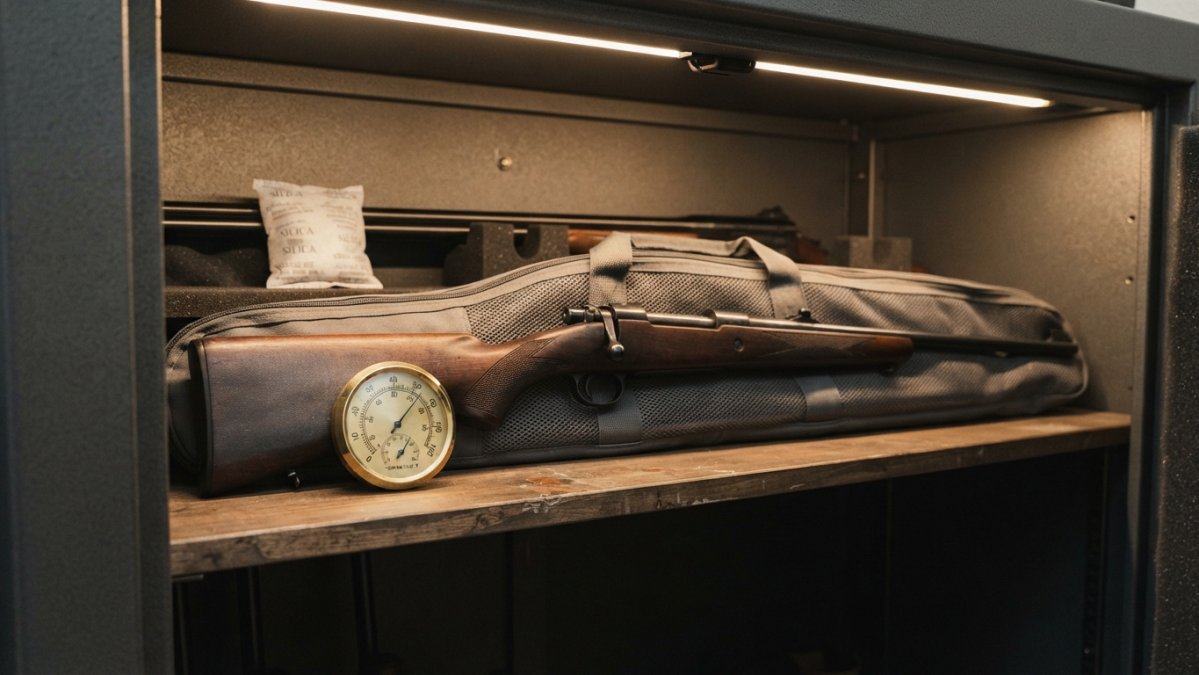
A hygrometer, a simple instrument that reads relative humidity, lets you check conditions in the storage space. Keep the space dry and avoid spots next to exterior walls, which can pick up condensation. Desiccant packs or a small dehumidifier can help in humid regions. A hygrometer on a shelf inside a dry gun safe, beside a cleaned rifle wrapped in a breathable storage bag, shows the kind of setup worth aiming for.
Selecting Long Term Gun Storage Bags, Cases, and Safes
Storage containers each solve a different problem, and the wrong container can undo a good cleaning job.
Breathable bags and soft cases. A silicone-treated gun sock or a padded soft case protects against dust, scratches and safe-interior dings, but it does little against humidity on its own. These work best in a climate-controlled room where the ambient air is already dry.
Hard cases with foam. A hard case with closed-cell foam holds shape and cushions the firearm, but open-cell foam can absorb and hold moisture against metal. If you use foam, choose closed-cell foam, and check the foam itself at each inspection for dampness or a musty smell.
Sealed safes and cabinets. A gun safe with a good door seal controls humidity better than any bag or case, but only if you manage the interior.
Vapor corrosion inhibitor (VCI) products. VCI inserts, emitters and bags release a vapor that deposits a protective film on metal surfaces.
Vacuum-sealed bags. Vacuum bags remove air and moisture and are effective for long-term storage of a cleaned, lightly oiled firearm, but they are a poor fit for a gun you may need to access quickly.
Watch out: a sealed container plus a damp firearm is worse than an open shelf, because the moisture has nowhere to go. Clean, dry and apply a thin protective film before the firearm goes into any container, and confirm the container's role: dust protection, humidity control, or both.
Use a storage container that you can open quickly and safely. A firearm you cannot access in an emergency is a safety problem, so balance protection against accessibility, and keep the key or combination available to authorized users only.
Building a Firearm Storage Inspection Schedule
Storage is not a set-and-forget task, and the most useful thing you can add to a stored firearm is a schedule tied to conditions rather than a fixed calendar.
Set the baseline interval by environment. Inspection frequency should reflect the conditions of the storage space, with more frequent checks in humid or unconditioned locations. Use the baseline as a starting point, then let your readings adjust it.
Let the hygrometer drive the schedule. Record the relative humidity inside the storage container at each check. If readings stay in a stable, dry range, you can stretch the interval. If readings climb or swing widely, shorten the interval and add or refresh desiccant.
Run a fixed inspection checklist at every check. Confirm the firearm is unloaded and the action is open before anything else.
Trigger an off-schedule inspection after any of these events: a move, a power outage that affected a dehumidifier, a season change, a firearm returning from a wet hunt or range session, or any sign of dampness in the storage area. These are the moments when stored firearms are most likely to pick up moisture.
Watch out: a schedule that only records "checked, fine" hides the trend you need. The humidity number and the specific findings are the useful part of the log, so write them down even when nothing looks wrong.
The table below summarises the key checks and their timing for a stored firearm.
| Check | What to look for | Action |
|---|---|---|
| Confirm unloaded | Action open, no ammunition | Do this first at every check |
| Surface rust | Bore, bolt face, slide, trigger group | Clean and re-protect |
| Protective film | Thin film still present by feel and sight | Reapply a thin coat |
| Wood stocks | Swelling, cracking, dull finish | Note and address |
| Foam, bags, desiccant | Dampness or musty smell | Replace or dry |
| Container seal and lock | Seal intact, lock works | Repair or replace |
| Humidity reading | Stable and dry, or rising between checks | Stretch or shorten interval |
| Off-schedule trigger | Move, outage, wet trip, dampness | Inspect immediately |
Returning a Stored Firearm to Service Safely
Before you shoot a stored firearm, treat it as you would any gun you have not handled in months. Confirm it is unloaded, remove the storage protectant and inspect the bore, which may hold a film of preservative.
Clean away the storage coating from the parts that need to move freely, then apply a light, appropriate lubricant to the friction points. If you are worried about sticky parts, this step-by-step guide shows how to avoid gummed up gun actions. Function-check the action with an empty chamber before loading any ammunition. If you find rust, stiffness or anything that does not operate normally, stop and have a qualified gunsmith inspect the firearm.
Frequently Asked Questions
How do you prepare a firearm for long-term storage?
Unload the firearm and check the chamber twice. Disassemble it as far as your owner's manual allows, then clean the bore, action, and contact points to remove fouling and old lubricant. Dry every metal surface completely, apply a thin coat of protective oil or a cleaner-lubricant such as SEAL 1 CLP Plus® Liquid, and wipe off the excess. Wrap the gun in a breathable cover and store it in a dry location.
How often should you inspect a firearm in long-term storage?
Inspect stored firearms every three to six months, and check more often if the storage area is humid or subject to temperature swings. Each inspection should look for surface rust, spotting on blued or stainless finishes, moisture inside bags or cases, and signs of pest activity. Record the date and findings so you can track changes over time and catch problems early.
What is the best way to prevent rust on a stored firearm?
Keep relative humidity below about 50 percent, remove all moisture before storage, and maintain a light, even protective film on metal parts. Avoid over-lubricating, because excess oil attracts dust and can gum up components. A product such as SEAL 1 CLP Plus® Paste, which is non-toxic and forms a protective barrier, can help, and a vapor corrosion inhibitor inside a sealed container adds another layer of defense.
Should you lubricate a firearm before storing it long term?
Yes, but apply lubricant sparingly. A thin film protects steel from moisture and corrosion, while heavy coats collect grit and can migrate onto wood stocks or other surfaces. Confirm that the lubricant is compatible with the gun's finish and with any storage materials you plan to use, and wipe off excess so that only a protective film remains.
Can firearms be stored in a gun safe long term?
A gun safe is a sound choice for long-term storage when it is kept dry and ventilated. Safes can trap humidity, so place a dehumidifier or moisture absorber inside, and check the interior periodically. Make sure firearms are fully dry and protected before they go in, because a sealed safe holds moisture in as well as out.
What should you use to protect a firearm during long-term storage?
Use a breathable gun sock or storage bag for basic protection, and a sealed case with desiccant or a vapor corrosion inhibitor for higher-humidity environments. Avoid plastic wrap or airtight bags without moisture control, since they can trap condensation against the metal. Pair the storage material with a clean, lightly protected firearm for the best results.
Should a firearm be stored loaded or unloaded?
Store firearms unloaded, with ammunition kept separately in a secure location. Unloaded storage reduces the risk of accidental discharge, prevents ammunition from degrading or corroding inside the gun, and lets you inspect the chamber and magazine during maintenance checks. Follow all applicable state and local storage laws, and secure access to keep the firearm out of unauthorized hands.
How do you safely return a firearm to use after long-term storage?
Begin by checking the gun for rust, moisture, or unusual residue. Clean off the protective coating thoroughly, since preservatives can affect function and ammunition performance. Inspect moving parts for smooth operation, then apply a light coat of appropriate lubricant. Test-fire with a small quantity of ammunition at a safe range before relying on the firearm for defense or competition.


