

Table of Contents
- Why Delicate Finishes Demand Careful Selection
- Understanding Finish Types and Their Vulnerabilities
- Gun Oil Safe for Blued Finish: Compatibility and Protection
- Non-Toxic Gun Lubricant Benefits for Indoor and Long-Term Storage
- How to Apply Gun Oil to a Firearm Without Damaging Finishes
- Gun Oil Rust Prevention for Extended Storage and Performance
- Choosing the Right Product Form for Your Needs
- Frequently Asked Questions
Last Updated: October 7, 2026
Why Delicate Finishes Demand Careful Selection
Choosing the right safe gun oil for delicate finishes is about preservation, not just protection. Standard cleaners can strip protective layers, cause pitting, or leave permanent marks that diminish function and value.
Your finish is a barrier against rust and oxidation. The solution is a safe gun oil formulated to clean, lubricate, and protect without degrading it.
Understanding Finish Types and Their Vulnerabilities
Not all finishes are equal. Two that look similar can react to the same product in opposite ways. The table below shows where an oil is safe, needs caution, or should be avoided.
| Finish | Typical Base | Main Vulnerability | Oil Chemistry to Avoid | Application Notes |
|---|---|---|---|---|
| Blued steel (hot caustic blue) | Carbon steel | Acidic or strongly alkaline cleaners; ammonia; prolonged wet contact | Acids, ammonia, chlorinated solvents | Wipe on, work in, wipe completely dry; never leave a wet film |
| Rust blued / slow rust blue | Carbon steel | Same as hot blue, but the oxide layer is thinner and more porous | Acids, ammonia, aggressive solvents | Treat as the most fragile metal finish; spot test first |
| Parkerized / phosphate | Carbon steel | Porous coating holds oil and moisture; aggressive solvents strip the phosphate | Acetone, MEK, strong degreasers | Light oil, thorough wipe-off; re-oil after any solvent contact |
| Nickel plating | Steel or alloy substrate | Ammonia and some solvents attack the plating; flaking at edges and screw holes | Ammonia, strong acids | Avoid ammonia-based cleaners entirely; wipe dry |
| Hard chrome | Steel | Very tolerant; main risk is trapped moisture at plating boundaries | Generally none for lubrication | Normal wipe-on, wipe-off |
| Stainless steel | Stainless alloy | Not rust-proof; pitting from chloride exposure and trapped moisture | Chlorinated solvents | Dry film preferred; keep crevices clear |
| Cerakote (H-series and C-series) | Cured ceramic-polymer | Solvent seepage into micro-cracks; some oils soften uncured or thin coats | Acetone, MEK, lacquer thinner | Wipe-on, wipe-off; avoid soaking |
| Anodized aluminum | Aluminum | Strongly alkaline or acidic cleaners etch the anodized layer | Lye-based cleaners, strong acids | Mild oil only; wipe dry |
| Varnish | Wood | Alcohol, ammonia, and many solvents soften or cloud the film | Alcohol, ammonia, acetone | Keep all gun oil off the wood; use a dry cloth only |
| Lacquer | Wood | Same solvent sensitivity as varnish, plus easy crazing | Alcohol, acetone, lacquer thinner | Dry cloth only |
| Shellac | Wood | Alcohol dissolves shellac almost instantly | Any alcohol | Dry cloth only |
| Oil-finished wood (tung, linseed, Danish) | Wood | Petroleum oils darken and gum; repeated exposure softens the film | Mineral oil, petroleum distillates | Dry cloth; re-oil with the original finish oil if needed |
| Polyurethane / catalyzed wood finishes | Wood | Fairly tolerant, but solvent-heavy products can dull the sheen | Acetone, lacquer thinner | Dry cloth; mild soap and water if needed |
Antique, Collectible, and Aged Finishes
A 100-year-old rifle's finish has been altered by decades of oxidation, handling, and prior cleanings. Three patterns recur:
- Aged bluing is thinner and more mottled than factory blue. The remaining oxide protects the steel, so anything that removes it, abrasive polishes, acidic cleaners, rough cloths, permanently reduces value and corrosion resistance.
- Original varnish, lacquer, and shellac on antique stocks often contribute most to collector value. One swipe of an alcohol-containing product can dissolve a century-old shellac film in seconds.
- Re-blued or refinished guns may look original but behave differently. A cold blue touch-up is far more reactive than factory hot blue.
For any collectible: no product touches the wood, and metal gets the gentlest oil applied with minimal cloth, then wiped dry. If unsure whether a finish is original, treat it as if it is.
How to Verify a Product's Claims
Manufacturer marketing, "safe for all finishes," "non-toxic," "won't harm bluing", is a starting point, not evidence. Two documents tell you more:
- The product label and warnings section. Look for listed solvents (acetone, MEK, toluene, xylene, ammonia, chlorinated compounds). If any appear, the product is not appropriate for delicate finishes regardless of the front of the bottle.
- The Safety Data Sheet (SDS). Section 3 lists hazardous ingredients and concentrations; Section 10 lists materials to avoid. Strong acids, strong bases, or chlorinated solvents are red flags for blued, Parkerized, nickel, and coated surfaces.
- The manufacturer's compatibility statement. A maker that publishes a finish-compatibility list has tested. A maker that only says "safe for firearms" has not.
Where independent testing doesn't exist, your own spot test is the only evidence.
The Common Thread
Two rules apply across every finish. First, avoid aggressive solvents: acids, ammonia, acetone, MEK, and chlorinated compounds are the recurring culprits. Second, control contact time and volume, a product harmless when wiped on and off can damage if it pools in a crevice or sits on a stock for hours. A bio-based, non-toxic gun lubricant that infuses into the metal and is wiped completely dry satisfies both rules on blued steel, Parkerized surfaces, nickel, Cerakote, anodized aluminum, and modern wood finishes, the safest default when you don't know what you're working on.
Gun Oil Safe for Blued Finish: Compatibility and Protection
Blued steel is the finish most often damaged by the wrong lubricant and most often misdescribed in marketing. Understanding why it fails tells you what to look for on a label.
What Bluing Actually Is
Hot caustic bluing converts the top few microns of steel into magnetite (Fe₃O₄), a black iron oxide. That layer is thin, well under a thousandth of an inch, and is part of the metal, not a coating like paint or Cerakote. Anything that dissolves or abrades iron oxide removes bluing permanently. Rust bluing produces the same oxide more slowly, leaving a thinner, more porous layer; cold blue solutions are the most reactive of the three.
Chemistries That Attack Bluing
- Acids. Even mildly acidic cleaners etch the oxide and leave a gray or white bloom. Avoid anything below roughly neutral pH unless the maker states it is bluing-safe.
- Ammonia. Common in copper-fouling removers; attacks bluing and nickel plating.
- Chlorinated solvents. Can promote pitting on carbon steel, especially in humid storage.
Chemistries That Are Generally Safe
Bio-based lubricants, applied sparingly and wiped completely dry, are often recommended for blued steel. They dissolve carbon and fouling without the acid or ammonia load, and because the carrier penetrates rather than sits on top, no wet film traps moisture. That said, "bio-based" is not a synonym for "safe on bluing", a plant-derived formula can still contain an acidic additive or solvent.
A Practical Test Protocol
Before committing a new product to a blued firearm, run this sequence on an inconspicuous area, inside the trigger guard, under the grip panel, or on the underside of the barrel:
- Clean the test area with a dry microfiber cloth and photograph it.
- Apply a small amount of product with a clean cloth. Do not spray directly onto the finish.
- Let it sit 24 hours at room temperature, longer than any normal cleaning cycle, surfacing slow reactions.
- Wipe completely dry with a fresh cloth.
- Compare against the photo under the same light. Look for color shift, cloudiness, a white or gray bloom, or any change in sheen.
- If nothing changed, proceed. If anything changed, do not use the product on that firearm.
Application on Blued Steel
The wipe-on, wipe-off method is standard for a reason. Apply a small amount to a microfiber cloth, not directly to the gun, work it into the metal to lift carbon and fouling, then wipe with a clean, dry section of cloth until no visible film remains. Pay attention to crevices, screw heads, and the barrel-receiver junction, where oil pools and bluing is thinnest.
Non-Toxic Gun Lubricant Benefits for Indoor and Long-Term Storage
A non-toxic gun lubricant offers practical advantages beyond environmental responsibility. If you clean firearms indoors, traditional solvents create health concerns: VOCs from mineral oils and harsh cleaners accumulate in confined spaces, causing respiratory irritation and headaches. Bio-based formulations don't off-gas the way traditional solvents do, making them safer for repeated indoor use. For long-term storage, traditional oils can gum up, separate, or become acidic over years, while a quality bio-based lubricant maintains its protective properties without degrading, whether you shoot weekly or annually.
How to Apply Gun Oil to a Firearm Without Damaging Finishes
Proper application technique is as important as product selection. Even the safest gun oil can cause damage if applied carelessly.
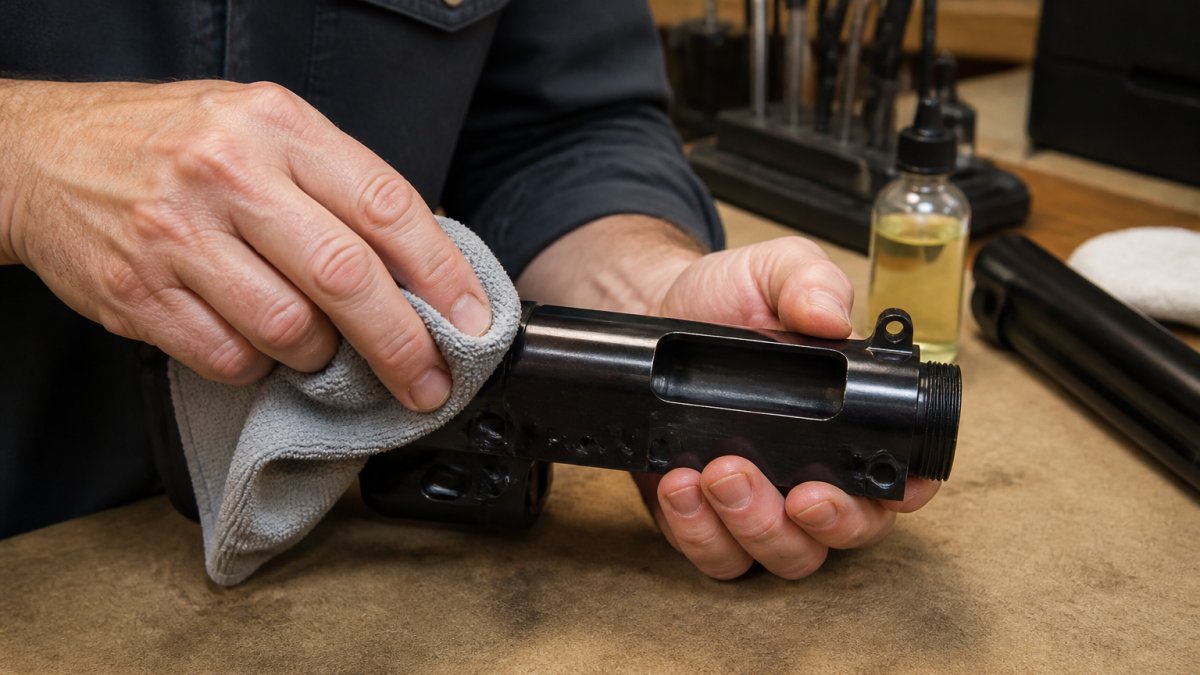
Spot Testing and Safe Application
Before committing to a new product, spot-test on a small, inconspicuous area like the inside of the trigger guard or the bottom of the receiver.
Use minimal product. A small amount on a microfiber cloth, like The Gun Rag ($10.45), goes a long way. Work it into the metal, especially rust-prone areas: the bore, chamber, and crevices where moisture collects.
Wipe-Off Technique for Delicate Finishes
The wipe-off is where most people go wrong. Many shooters leave a thin oil layer on the finish, thinking it provides ongoing protection. In reality, that residue traps moisture and accelerates corrosion on delicate finishes. For blued steel, Parkerized finishes, and specialty coatings, wipe completely dry with a clean, dry cloth, removing every trace of visible oil. The protection comes from what infused into the metal, not what sits on top.
Leaving oil residue on delicate finishes is the most common cause of finish damage. Moisture becomes trapped under the oil layer, causing rust bloom and pitting. Always wipe completely dry.
Gun Oil Rust Prevention for Extended Storage and Performance
Rust prevention is the primary job of any gun lubricant. A safe gun oil for delicate finishes must accomplish this without the aggressive chemistry that damages the finish itself.
The best approach combines two mechanisms: a protective barrier infused into the metal, and a dry surface that doesn't trap moisture.
Firearms stored for months or years require protection that lasts.
Choosing the Right Product Form for Your Needs
SEAL 1 offers multiple formats to match your maintenance style and firearm type. Each form delivers the same core benefit, cleaning, lubrication, and protection, but with different application characteristics.
| Product Form | Best For | Starting Price | Application |
|---|---|---|---|
| CLP Plus® Liquid | General maintenance, bore cleaning | $10.35 | Apply with patches or cloth, wipe dry |
| CLP Plus® Paste | Thick residue, detailed work | $9.85 | Apply with cloth or brush, wipe completely |
| The Gun Rag | Quick field maintenance | $10.45 | Pre-saturated microfiber cloth, wipe and go |
| SEAL SKINZ™ Patches | Bore and chamber cleaning | $8.99 | Pre-saturated cotton patches, caliber-specific sizes |
| CLP Plus® Aerosol | Precision application, tools | $24.95 | Spray directly, wipe off excess |
For delicate finishes, the paste or pre-saturated cloth options work best because they give precise control over application volume.
Choosing a safe gun oil for delicate finishes protects both your firearms and your investment.
Frequently Asked Questions
What gun oil is safe to use on delicate finishes like blued steel?
Bio-based, non-toxic gun oils formulated as all-in-one cleaners, lubricants, and protectants are safest for delicate finishes. These products dissolve carbon and fouling without harsh solvents that can pit or strip blued steel. Always spot test on a hidden area first. SEAL 1 CLP Plus® Liquid ($10.35) and Paste ($9.85) are designed to work on all metal finishes, including blued and Parkerized surfaces, while forming a protective barrier against rust and corrosion.
Can gun oil damage a firearm's finish if applied incorrectly?
Yes. Traditional harsh solvents and heavy oils left on delicate finishes can cause pitting, discoloration, and accelerated corrosion. The key is application and removal: apply the product, work it in to dissolve residue, then wipe thoroughly. SEAL 1 CLP Plus® is formulated as a dry lubricant that performs best when completely wiped off, leaving behind only a protective infused layer without excess residue that could damage antique or delicate finishes.
How often should I apply gun oil to prevent rust on firearms in storage?
For long-term storage, apply gun oil once during initial preparation, then inspect every 3-6 months. Reapply if you notice any surface oxidation or if the firearm will be stored in high-humidity conditions. Non-toxic, bio-based formulas like SEAL 1 CLP Plus® create a lasting protective barrier that infuses into metal, reducing the frequency of reapplication compared to conventional oils that evaporate or wash off more easily.
Is non-toxic gun lubricant as effective as traditional solvents for cleaning?
Modern non-toxic gun lubricants dissolve carbon and fouling on contact without the harsh fumes and skin irritation of traditional solvents. Bio-based formulas are equally effective at removing lead, copper, and carbon buildup while being safer for indoor use and the environment. SEAL 1 CLP Plus® dissolves carbon on contact and protects against further accumulation, making it suitable for competitive shooters, range users, and those shooting indoors where ventilation may be limited.


