

Table of Contents
- Why Gun Actions Get Gummed Up and How to Spot It
- How to Clean a Gun Action Without Full Disassembly
- How Much Oil to Use on a Gun and Why Less Is More
- Common Gun Cleaning Mistakes That Lead to Sticky Actions
- Firearm Maintenance in Cold Weather and Storage
- Your Firearm Cleaning and Lubrication Schedule
- When to Stop and Call a Gunsmith
- Frequently Asked Questions
Last Updated: October 5, 2026
Why Gun Actions Get Gummed Up and How to Spot It
Gummed up gun actions turn a reliable firearm into a liability, and they're almost always preventable. Spotting the causes early keeps your firearm mission-ready.
Common causes of sticky actions
Gun actions accumulate gunk from multiple sources.
Excess lubricant is another major offender.
Incompatible solvents and lubricants cause problems too. Mixing products or using solvents that don't fully evaporate leaves residue that attracts fouling. Cold makes it worse: excess lubricant thickens and slows the action.
Warning signs of buildup
Catch a gummed up gun action early. Warning signs include:
- The bolt or lever moves slower than normal
- The trigger feels sticky or requires extra pressure
- You notice a dark, crusty buildup around the action
If you notice any of these, don't wait. A few minutes of cleaning now prevents hours of troubleshooting later.
How to Clean a Gun Action Without Full Disassembly
You don't need a full teardown to address a gummed up gun action. Field stripping, the partial disassembly most firearms allow, gives you access to the parts that matter.
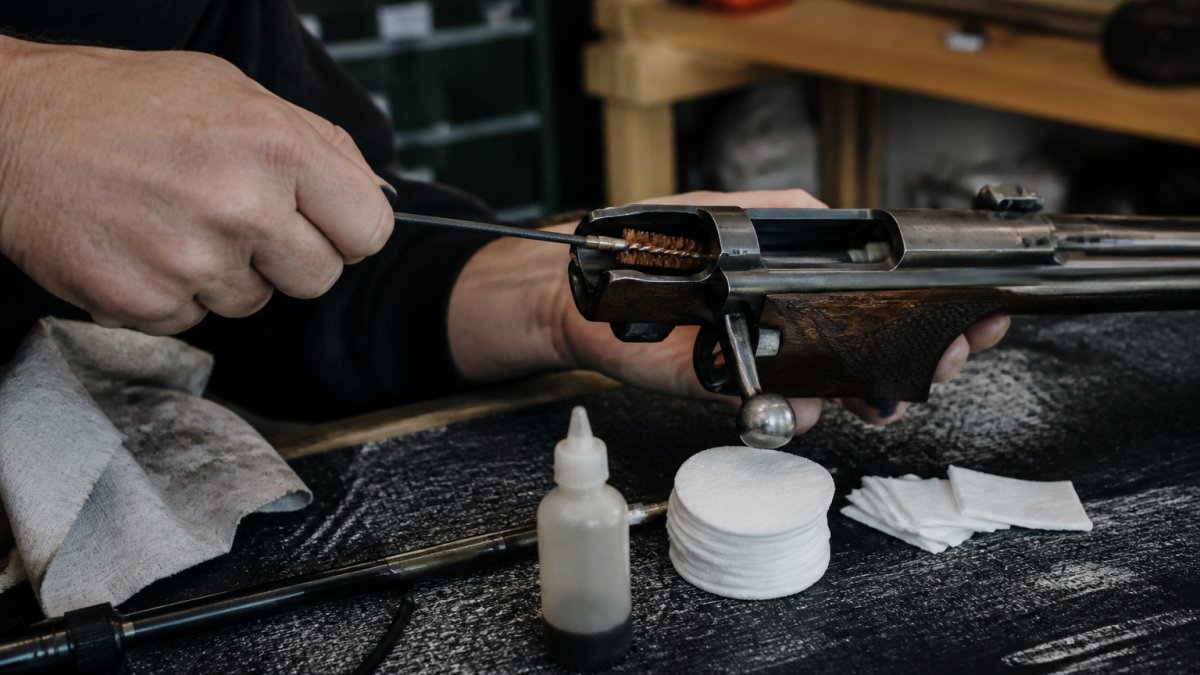
Safe field stripping and partial takedown
Start by ensuring your firearm is unloaded: point it in a safe direction, check the chamber, and remove the magazine.
For most rifles and shotguns, field stripping involves:
- Remove the bolt or lever assembly (consult your manual for your specific model)
- Set the receiver aside on a clean cloth
- Inspect the action area for visible fouling and debris
You're not going deep into the internals, just creating enough access to see and reach the problem areas. Most modern firearms allow this in under five minutes.
Removing powder residue and fouling from the action area
With the bolt removed, gently scrub the action surfaces with a cleaning brush, working from breech toward muzzle.
Apply solvent to a patch and wipe the action; if stubborn, let it sit a minute or two.
For hardened buildup, use a brass brush with light pressure to remove gunk without scratching the metal.
Cleaning the chamber and breech
The chamber and breech take the brunt of powder residue and carbon, so most fouling accumulates there.
Use a caliber-appropriate chamber brush with solvent, rotate it several times, then run dry patches until they come out clean, usually three to five.
For the breech, wrap a patch around a cleaning rod and work it back and forth, repeating with fresh patches until no fouling appears.
How Much Oil to Use on a Gun and Why Less Is More
This is where most shooters make their biggest mistake: applying lubricant like they're protecting a firearm from the desert, when they should apply just enough to prevent rust and ensure smooth operation.
The role of lubricant choice in preventing buildup
Lubricant type matters as much as amount. Heavy, sticky oils attract dust and carbon; light, fast-drying lubricants don't accumulate gunk the same way.
Bio-based, non-toxic formulas like SEAL 1 CLP Plus penetrate metal without a thick residue: they clean, lubricate, and protect, then you wipe off the excess, preventing the gummy buildup oversaturation causes.

Incompatible lubricants compound the problem: mixing an old, thick oil with a newer product creates sludge that traps particles. Stick with one product, consistently.
Applying the right amount to action components
The practical method: apply a thin coat of lubricant to the action surfaces with a patch or brush, then immediately wipe it off.
The lubricant bonded to the metal protects it; the excess on the surface collects gunk.
For a rifle or shotgun, this means:
- One small patch with lubricant on the bolt
- One patch on the action rails
- A light coat on the chamber area
Total time: two minutes. Total lubricant used: a fraction of what most shooters apply.
Common Gun Cleaning Mistakes That Lead to Sticky Actions
Most shooters repeat the same errors. Knowing what to avoid keeps you from creating the problem you're trying to prevent.
Excess solvent and over-lubrication
Pouring solvent into the action and letting it sit invites gummy buildup. Solvents that don't fully evaporate leave residue that attracts powder and dust, hardening into a gummy paste.
The fix: use solvent sparingly.
Over-lubrication is equally damaging. A firearm doesn't need to be wet with oil, a light film suffices.
Incompatible solvents and lubricants
Mixing products is tempting, but they may not work together: one may leave residue the other doesn't dissolve, creating a compound harder to remove than either alone.
Stick with one product system. SEAL 1 CLP Plus, for example, is an all-in-one cleaner and lubricant, used consistently, no chemical conflicts and no surprise buildup.

Skipping the wipe-down step
That excess sits on the metal, collects dust and powder over weeks and months, and hardens into a sticky mass.
Always end your cleaning routine with a dry patch on the action, chamber, and exposed metal. Thirty seconds prevents 90% of gummy action problems.
Firearm Maintenance in Cold Weather and Storage
Temperature and humidity are the variables most shooters ignore until an action goes gummy. Cold changes how moisture behaves inside the receiver, and long-term storage compounds it.
How cold and condensation actually gum up an action
Bring a cold firearm into a warm room and condensation forms on every metal surface, including the receiver interior and firing pin channel.
A common pattern: a rifle cycles perfectly at the range in October, sits in a case through a humid spring, then feels sluggish on the first shot of the next season.
A diagnostic checklist for existing gummy residue
Before cleaning, identify what you're dealing with. Dried lubricant, carbon fouling, and moisture-driven corrosion each need a different approach.
- Dried lubricant: Amber or brownish film, often tacky to the touch, concentrated on rails, bolt lugs, and the trigger group. Wipes off with a dry patch but returns if you re-oil heavily.
- Carbon and powder fouling: Matte black or dark gray crust, usually dry and slightly gritty. Common in the chamber, bolt face, and gas system areas.
- Moisture-driven corrosion: Orange or reddish-brown speckling, sometimes with pitting. Most often found under the stock line, around the trigger pins, and inside the receiver where condensation pooled.
Run a clean, dry patch through the action and inspect it under good light: a tacky brown smear means dried lubricant, gritty black means carbon, and orange means stop and address corrosion before shooting.
Storage conditions that contribute to sticky actions
Humidity is the primary driver, but temperature swings matter just as much. A safe in an unconditioned garage can swing 30-40°F daily, pulling moisture in and out of the metal.
Desiccant packs help but saturate: a 40-gram silica gel pack in a typical gun safe lasts roughly 2-4 weeks in moderate humidity.
Pre-storage and pre-use routine
Before storing for more than a month:
- Clean the action and chamber thoroughly.
- Apply a thin film of lubricant and wipe off the excess.
- Run a dry patch through the bore and action.
- Place a fresh desiccant pack in the case or safe.
- Store in a cool, dry location with stable temperature.
Before the next use:
- Remove the firearm and let it reach room temperature.
- Cycle the action slowly and listen for grinding or hesitation.
- Inspect the bolt face, chamber, and trigger group with a light.
- If any tacky or gritty residue is present, clean before firing.
A firearm stored this way comes out clean and ready; one stored with excess lubricant or moisture comes out gummy and unreliable. The difference is almost always the storage routine, not the firearm.
Your Firearm Cleaning and Lubrication Schedule
Most cleaning schedules tell you when to clean, not how much lubricant to apply, which to use for your conditions, or how to adjust when the environment changes. That gap leads to gummed-up actions: a shooter follows a schedule, over-lubricates, and creates the problem the schedule was meant to prevent.
Match lubricant quantity to action type and use
The right lubricant amount depends on action design and use.
- Bolt-action rifles: A very light film on the bolt lugs, cocking cam, and raceways. Bolt actions tolerate less lubricant than semi-autos because the camming force is mechanical, not gas-driven. Excess oil on a bolt action migrates into the trigger group and collects dust.
- Semi-automatic rifles and pistols: A light film on the bolt carrier, rails, and cam pin. These actions run hotter and cycle faster, so they need slightly more lubricant than a bolt gun, but still a film, not a pool. If lubricant is visible as a bead or drip, it's too much.
- Shotguns (pump and semi-auto): Light film on the action bars, bolt, and shell carrier. Pump guns are the most forgiving, but excess lubricant in the receiver traps unburned powder and wad debris, which is a common source of sticky actions in the field.
A useful rule: if you can see the lubricant, you've applied too much. The goal is a bonded film that protects metal, not a visible coating that collects debris.
Adjust the schedule for exposure conditions
Use, storage, and exposure should drive the schedule more than the calendar.
| Condition | Clean | Lubricate | Inspect |
|---|---|---|---|
| Range session, dry weather, under 100 rounds | Wipe down, bore snake | Light film, wipe excess | Before next use |
| Range session, 100+ rounds or suppressed | Full action clean | Light film on contact points | Before next use |
| Rain, snow, or high humidity exposure | Clean same day | Light film, wipe excess | Next day for condensation |
| Saltwater or coastal exposure | Clean same day, flush with fresh water-dampened patch | Light film after drying | Daily for 3 days |
| Stored 1-3 months | Clean before storage | Protective film, wiped | Before use |
| Stored 3+ months | Clean before storage | Protective film, wiped | Before use, plus desiccant check |
When to clean after use or exposure to moisture
Clean after every shooting session, powder residue hardens within days and carbon accelerates fouling. After wet-weather or saltwater exposure, clean the same day; moisture mixed with powder residue creates corrosion that's far harder to remove later.
If you've stored a firearm for weeks or months, inspect before shooting: cycle the action slowly, and if it feels sluggish or shows dark residue, clean before firing.
Maintenance intervals by shooting frequency
Weekly or more:
- Clean after every session
- Apply a light film to action and chamber
- Wipe off excess with a dry patch
Monthly or less:
- Clean after each use
- Apply a protective film before storage
- Inspect before the next session
Rarely or seasonally:
- Clean thoroughly before storage
- Apply a protective film to all metal
- Store with fresh desiccant packs
The wipe-down rule that prevents most gummy actions
End every cleaning session with a dry patch on the action, chamber, bolt face, and exposed metal.
If you follow one rule from this article, make it this: lubricate lightly, then wipe. The film that remains protects the firearm; the excess you remove is what would have gummed it up.
When to Stop and Call a Gunsmith
Sometimes a gummed up gun action is beyond home cleaning. Knowing when to stop prevents damage.
If you notice grinding, resistance that feels wrong, or damage to the action surfaces, stop immediately, forcing the action can cause permanent damage.
If you're uncomfortable disassembling your specific firearm, don't guess. A gunsmith's time is cheaper than replacing a damaged rifle or shotgun.
A gummed up gun action is almost always preventable through proper cleaning, light lubrication, and consistent maintenance. SEAL 1 CLP Plus makes this easier: its bio-based formula cleans, lubricates, and protects in one step, then wipes clean to leave no excess residue behind. Get started with SEAL 1 CLP Plus Liquid ($10.35) or the Complete Gun Care Kit ($44.99) and experience the difference a proper maintenance system makes.

Frequently Asked Questions
What causes a gun action to get gummed up?
Gummed up gun actions result from a combination of powder residue, fouling, and excess lubricant that hardens over time. Moisture exposure, especially in humid or cold conditions, accelerates this buildup. Using incompatible solvents or over-lubricating the action area creates a sticky paste that collects carbon and debris. Solvents that evaporate too slowly can also leave residue behind, particularly if not properly wiped off after cleaning.
How much oil should you use when lubricating a firearm action?
Apply only a light, thin coat of lubricant to action components, think a light sheen, not a wet appearance. One or two drops on a patch is typically sufficient for the entire action area. SEAL 1 CLP Plus® is formulated as a dry lubricant that performs best when completely wiped off the firearm, leaving behind a protective infusion in the metal rather than a slick residue. This approach prevents the accumulation of excess oil that attracts powder residue and dust.
How often should you clean and lubricate a firearm?
Clean your firearm after every shooting session, especially if exposed to moisture, dust, or extreme temperatures. For firearms in storage, inspect and maintain them every 3-6 months. Competitive shooters may clean between matches. Cold weather and wet conditions require more frequent maintenance. A firearm-specific maintenance schedule depends on your use frequency, environment, and storage conditions, regular shooters benefit from weekly or bi-weekly field checks during active seasons.
Can too much gun oil make a firearm action sluggish?
Yes. Excess oil creates drag on moving parts and accumulates powder residue, creating a gummy buildup that slows the action. This is why SEAL 1 CLP Plus® is designed to be wiped off completely after application, leaving only a protective infusion in the metal. Over-lubrication is one of the most common mistakes that leads to sticky actions. A light application followed by thorough wiping ensures smooth operation without the risk of buildup.


